Saturday, February 22, 2014

Infographics and the Water Crisis

Table Etiquette Infographic

For about a year now, I have been enamored with the infographic.  I absolutely love these visual displays of information.  If you aren't familiar with the infographic, have a little fun today - Google the term and see what you find.  Then, Google it with the name of a topic, like 'shark' and 'infographic'.   I guarantee you will will find yourself lost in a visual feast of engaging facts, many of which you should know, and many that are unnecessary, yet fun.  One of the many things I like about the infographic is its ability to condense what would be large amounts of text into reasonable chunks of words and illustrations.  It makes learning fun!
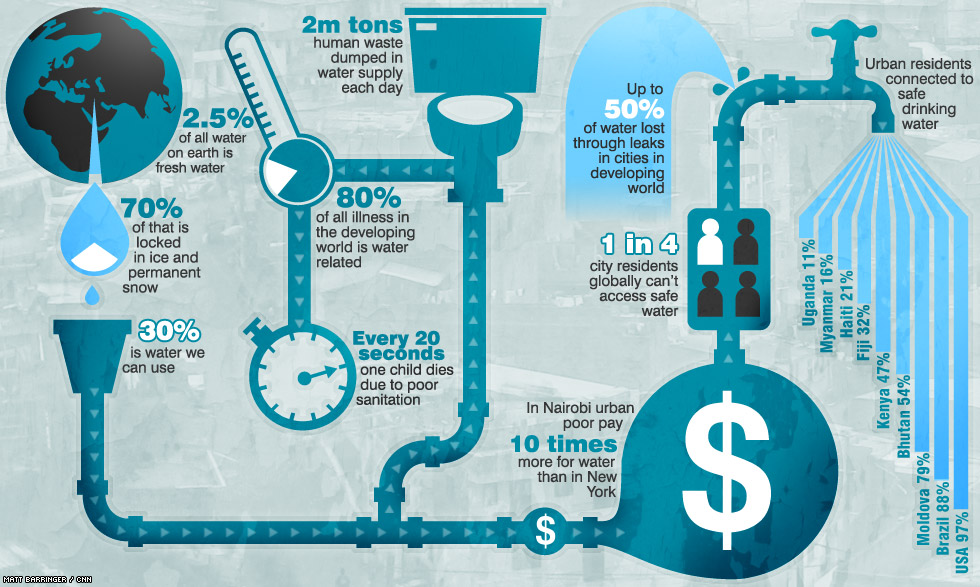
The Secret Life of Drinking Water

While designing our persuasive writing unit, I kept this in mind.  One of my goals was to get students engaged deeply in a topic that they hadn't necessarily given significant thought to before.  Since infographics about table etiquette and the snowy owl captivated me every time, I figured it might work with the kids.  For this particular exercise, I chose water; something we regularly take for granted.  I shared four different infographics that I wanted them to consider: How Much Water is Your Home Wasting?, The Miracle of Water, The Secret Life of Water, and Why Water Matters.  The kids were given a graphic organizer to pull out the main details of each, as well as to help them write summaries.  In partners, they analyzed, made judgements, and compiled the information.  Not surprisingly, like me, they were astounded by what they learned.  Did you know that every 20 seconds a child dies from a water-related sickness?

The next step will be for the students to create a persuasive paragraph based on what they have learned.  I suspect that many will write impassioned pleas to change the world.  That's great!  While not everyone may have a realistic solution, they will still be practicing the art of argument.  In the future, I may even have them create their own infographics.  There are many great, free resources out there and the possibilities would be endless!

1http://hydratinghumanity.org/why-water.php

Wednesday, January 29, 2014

Bringing Writing to Life


It started this week!  Two sections of English had their first chance to use Kidblog in my class (the other two will next week).  We began by selecting avatars and tweaking our usernames - no last names, correct capitalization, please!  Who would have imagined that choosing an avatar could be such a time-consuming process? Because our first few forays in blogging will be facilitated by me, I introduced the kids to this week's online discussion:  Is it acceptable for teachers to friend students on Facebook or other social media sites (Instagram, Vine, etc.)?  Why or why not?  Of course, many kids had an immediate and strong opinion, but I wanted to them to think.  Before they were allowed to write any responses on the blog, they were expected to formulate their ideas, with at least two strong reasons, and share them with multiple partners.  This sharing activity helped them to think logically and reasonably.  Following the partner discussions, I reviewed my writing expectations: complete sentences; correct spelling, punctuation, and grammar; and no texting dialect.  I also asked them to draft their response to the question in Pages, first.  Once the drafts were ready, kids copied and pasted them in Kidblog and we were rolling.  Students participated in a series of responses and replies as they engaged in a digital conversation.  It may have been one of the quietest 30 minutes in my room this year!

I was thrilled with the day's activities, but I am even more excited about the future of blogging in my classroom.  As kids become more proficient with the process, I plan to release control of the discussion.  I want the students to see themselves as passionate individuals who have something to say to their peers.  It is my hope, that by the end of the semester, kids will be writing their own posts and commenting on one another's ideas without relying on a topic suggestion from me.  It will be even more powerful when the sixth graders start to hear from others around the country.  I can't imagine a more motivating experience than writing for an authentic audience.  Finally, those words will come alive as they inspire discussion and debate!  

Wednesday, January 15, 2014

Group Projects and Individual Accountability

Before Winter Break, the kids began the study of Greek mythology.  Not only is it a massive undertaking, it is also a complicated one.  The gods have tangled family trees, and the myths are often inconsistent from one source to another.  This year, rather than deluging the kids with copious amounts of information, I was inspired to approach the unit from another angle.  Why not divide the material among small groups and let them teach their classmates?  With that in mind, I split the grade into 20 small groups, charging each with developing the 'criminal profile' of their assigned mythical character.  For those of you familiar with mythology, its cast of characters struggles to make ethically sound decisions.  My feeling was that we could study those choices, learn about the gods, and explore the relevancy of stories that are thousands of years old.


Year after year, I have heard from students who have legitimate concerns when it comes to assessing group work.  Usually the complaint is that one student has done most of the work while another student has done very little.  Obviously, this is a problem because inherent in group work is a group assessment.  So, if the final product is worthy of an 'A', how can I ensure that all members are getting a fair grade?  There are a number of different methods that can be employed to address this issue.  One way is through self-assessment and reflection.  Group members assess themselves, each other, and then write a reflection of their contributions to the project.  I was taught another one this summer during the project-based learning conference here at USM.  Teachers from High Tech High in San Diego demonstrated how they hold individuals accountable within a group.  I have decided to adopt their method.

Here's how it works.  For the mythology project, each group is responsible for a number of deliverables.  These are the various components that make the greater whole.  In this case, groups need to complete a wanted poster, a criminal profile, and a screencast.  Let's consider creating the wanted poster, which involves the requisite research, source comparison, and note taking.  After students were given instruction, an example, and rubrics, they were required to create their own individual drafts of the poster.  Those drafts were brought to class for peer and teacher feedback.  The kids were given time to make revisions to their work, and the finished individual posters were submitted to me for grading.  Once returned, the group is expected create one poster that reflects the best of each of the individual submissions.  In this process, the students will receive two grades.  The first will be for their individual poster, while the second will be for the group product.  In this manner, members from the group will not be earning the same grades, but rather ones that reflect individual accountability. High Tech High teachers have found that this method holds students accountable to the group and tends to distribute responsibility more equitably.  I believe that they may be on to something.  Overall, the individual wanted poster submissions demonstrated thoughtfulness and care.  Now, I am looking forward to seeing if the group effort follows suit.